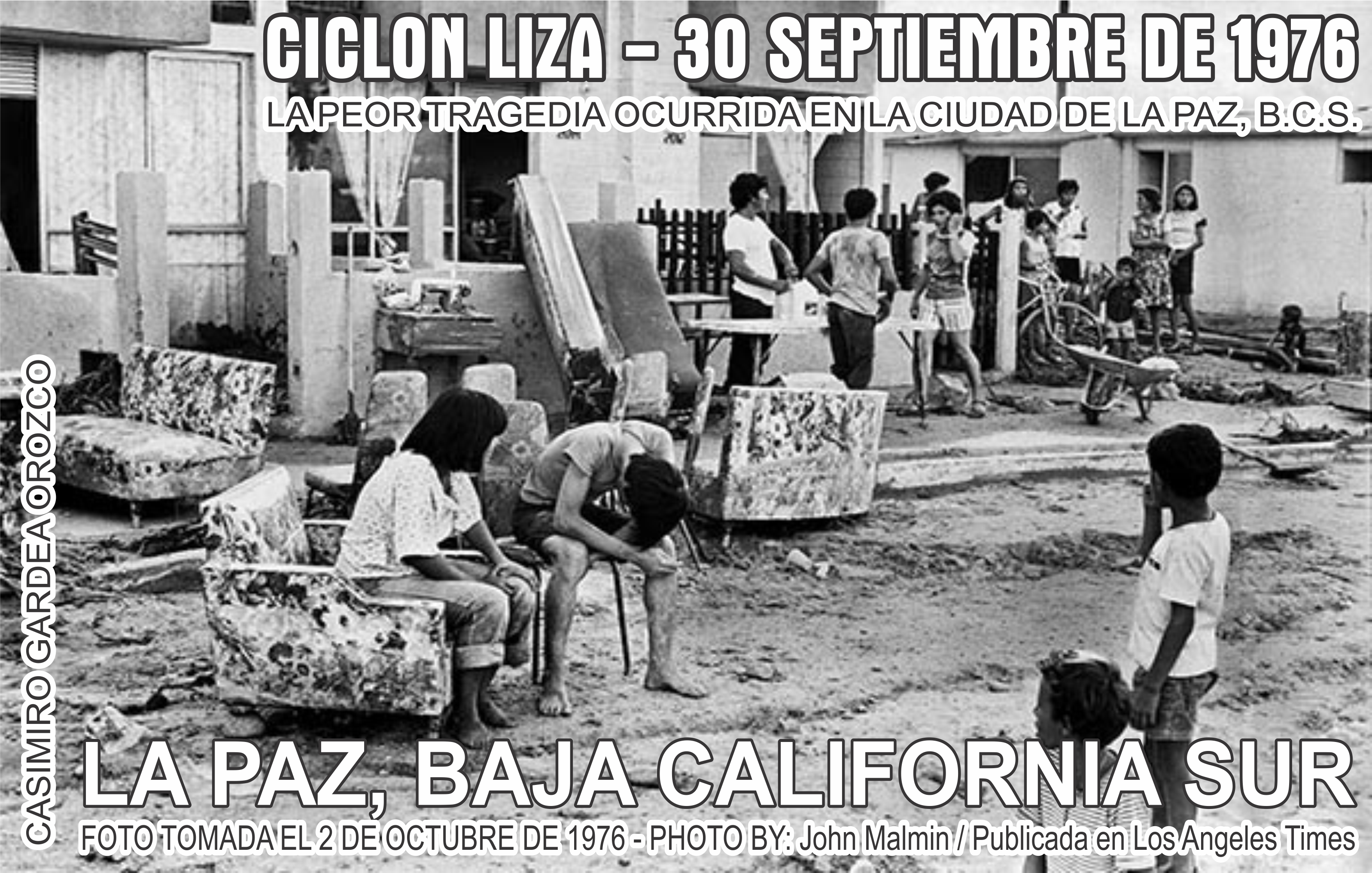
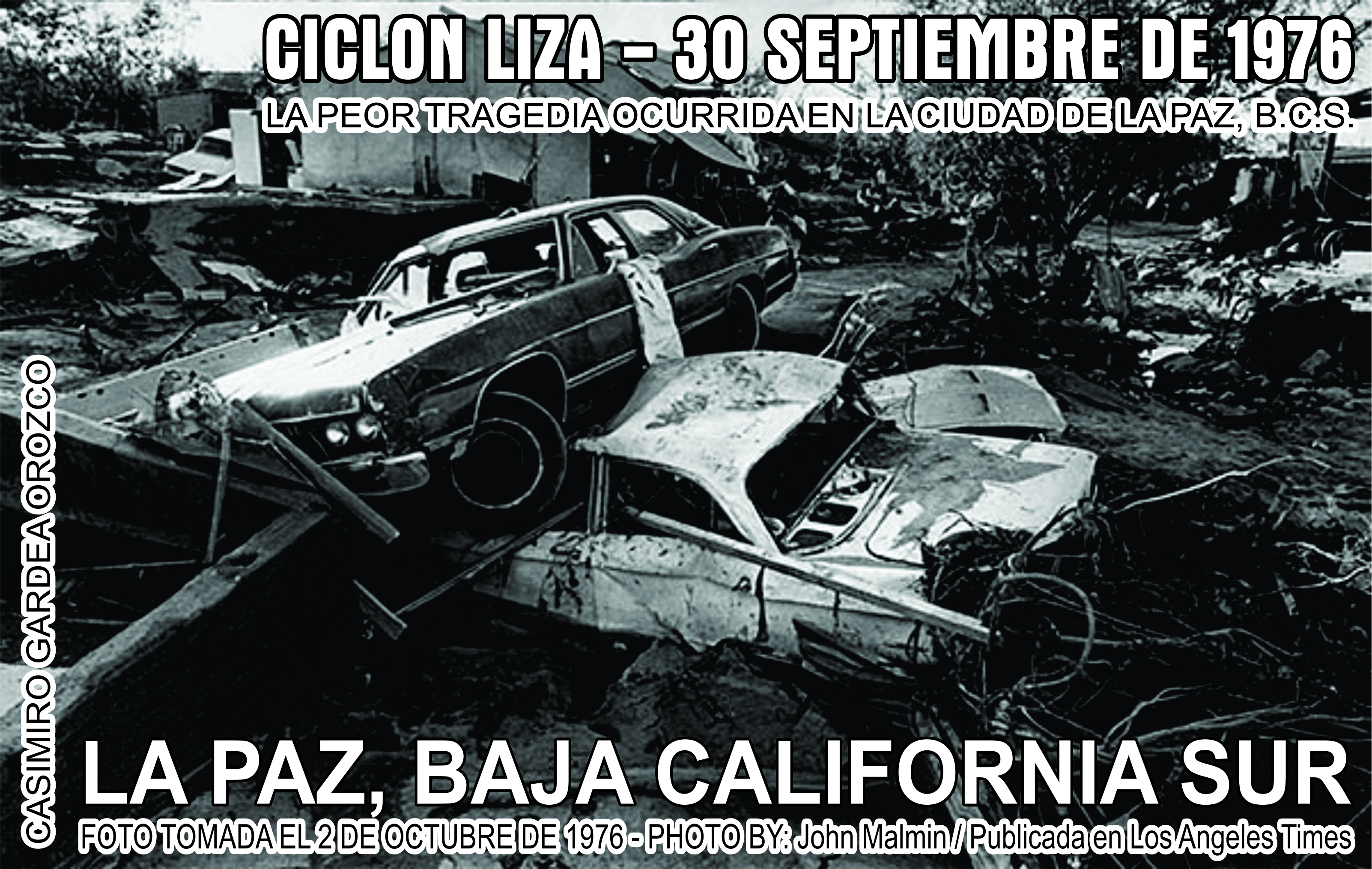
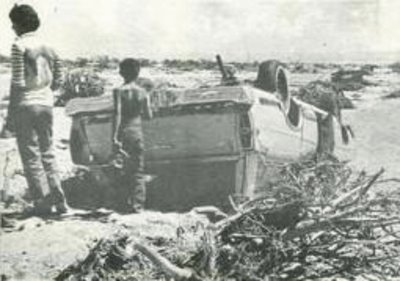
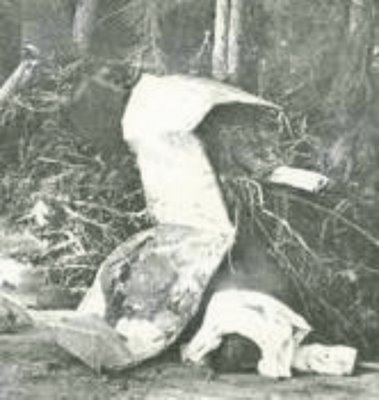
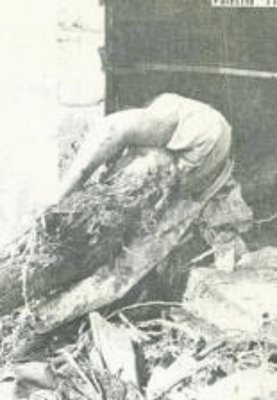
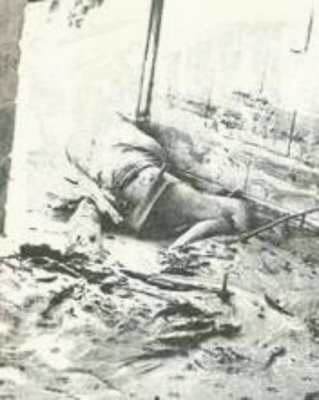
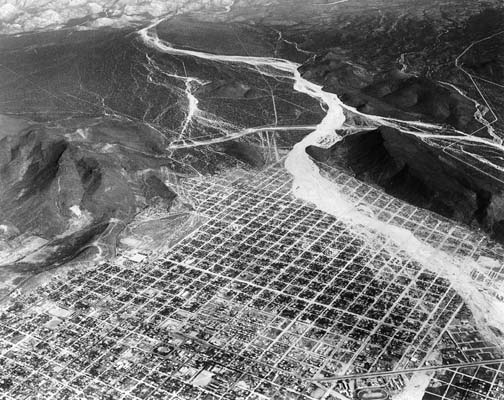
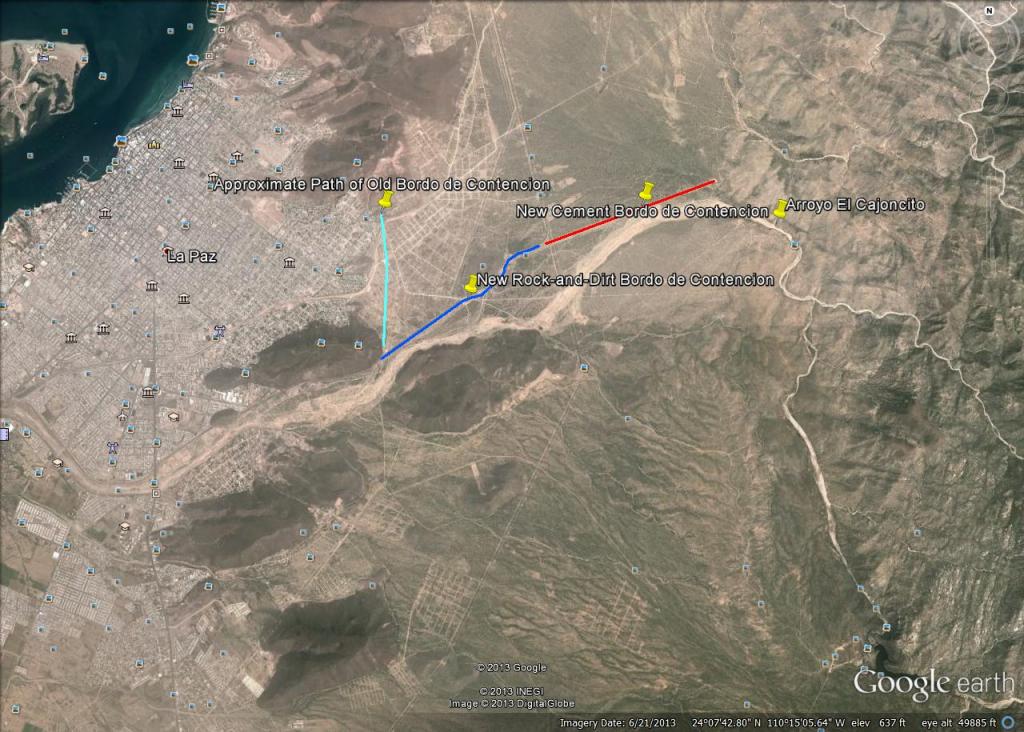
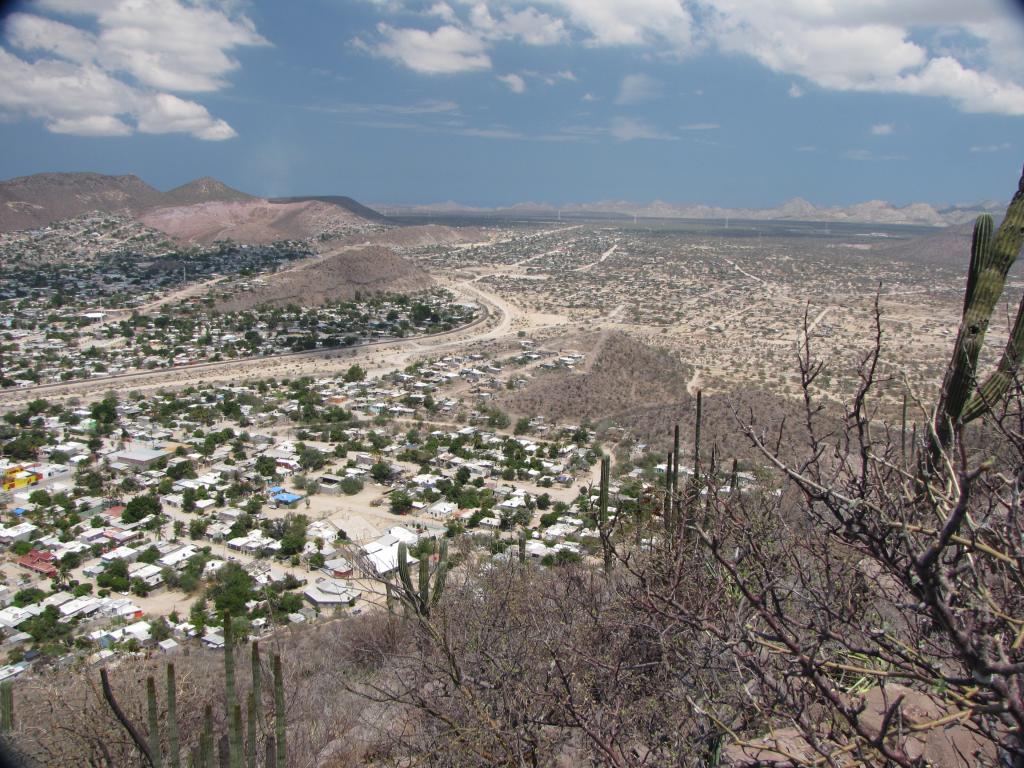
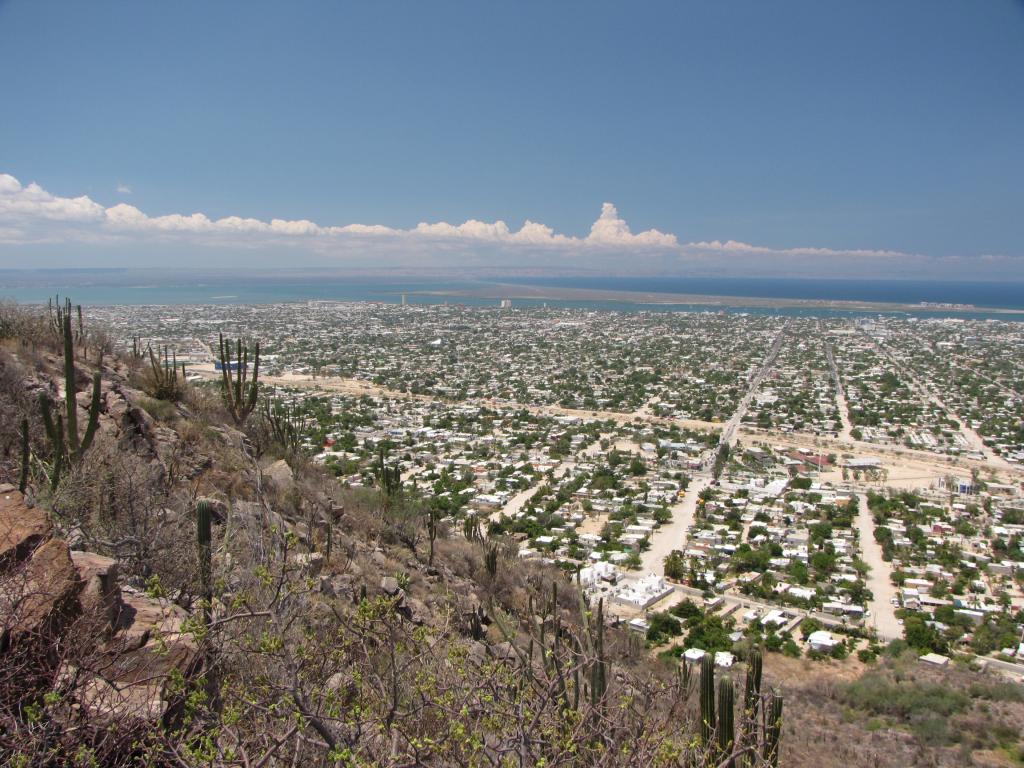
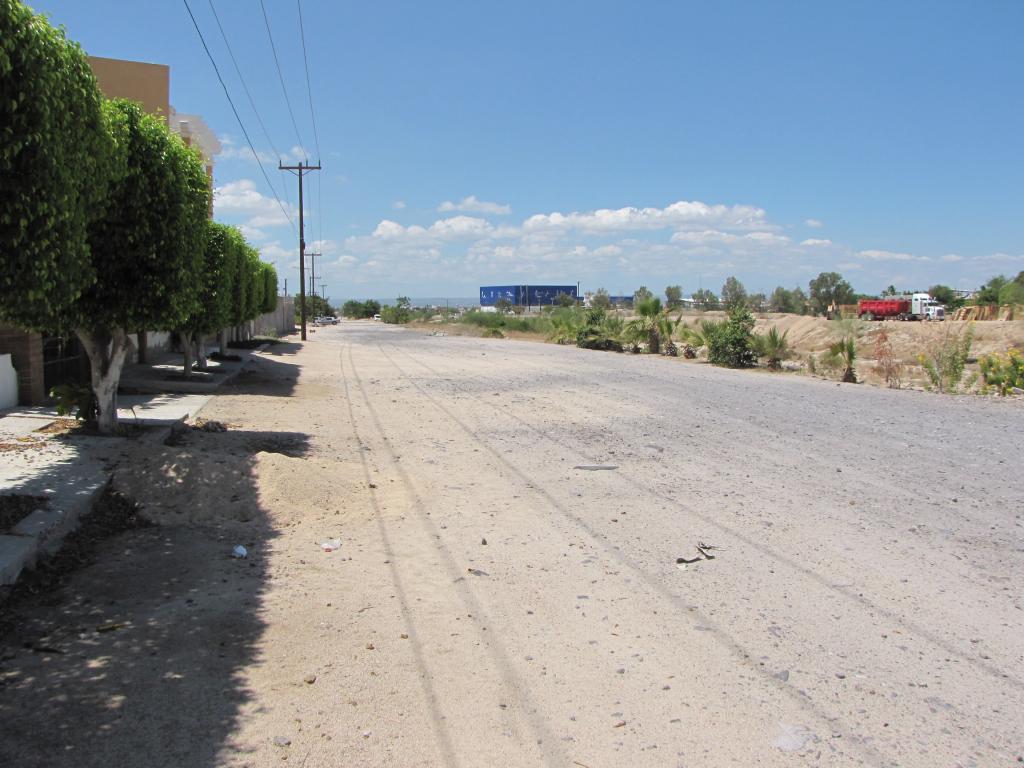
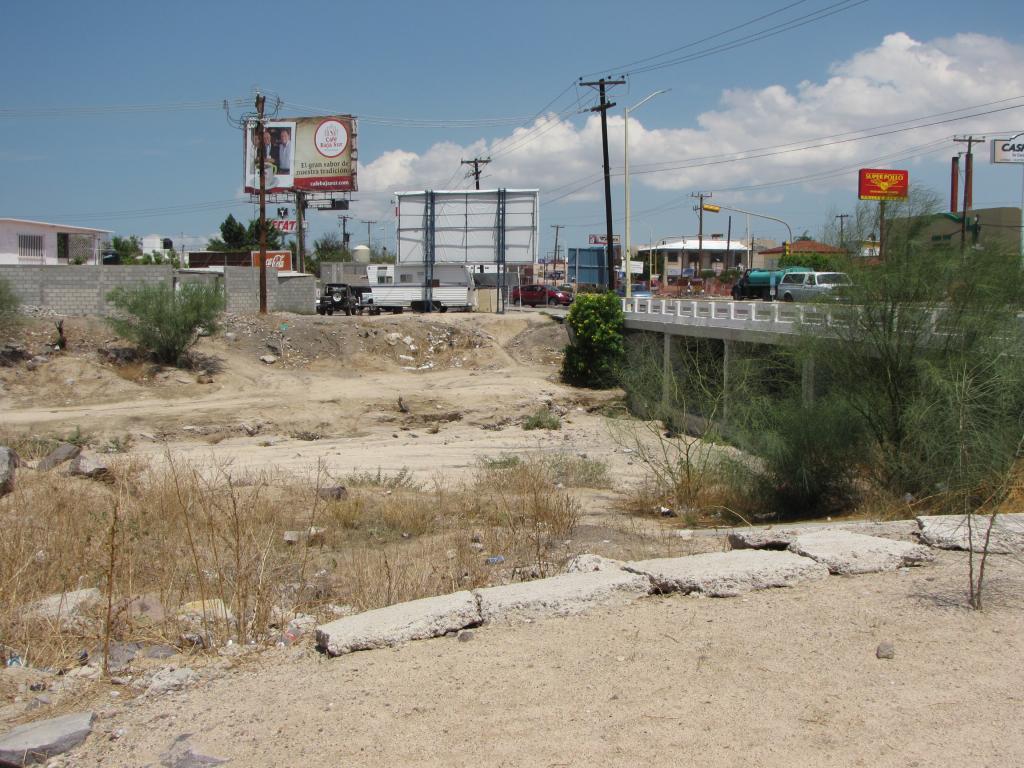
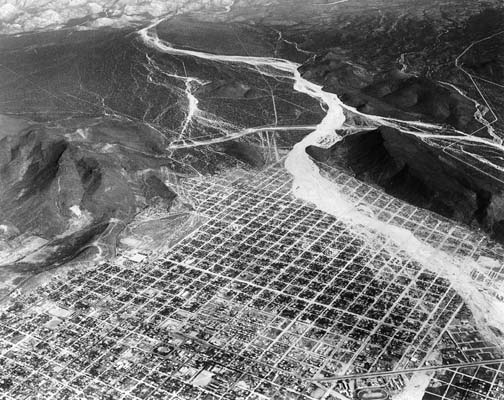
Arroyo El Cajoncito is actually the convergence of several major arroyos that drain a sizable area of the sierras east of town.
The
arroyo gets its name from a rocky “bottleneck” that forms a narrow
gateway where the arroyo leaves the sierras that the waters must pass
through. Once the waters clear the bottleneck at El Cajoncito, they make
their way to the sea through five large arroyos that flow over the
alluvial plain that La Paz is built on (in fact, they are responsible
for bringing from the nearby hills the material the city’s built on). Or
at least, that is how things worked until the mid-1960s, before
government officials built a 10-meter high dike meant to block the
natural paths the old waterways took through the city and divert their
flows to the east and south of town to the Arroyo El Piojo (this arroyo
flows past the UABCS).
But
what the planners of the project hadn’t counted on was the severity of
the tromba (localized storm characterized by a heavy downpour) that
unloaded over the region east of the state capital on that fateful day. A
rare combination of meteorological factors converged over the sierras
east of La Paz and reportedly dropped 800 highly-localized millimeters
(over two and a half feet) of rain in just over an hour. Initially, the
bottleneck at El Cajoncito Arroyo and a low area to the north of it
known as Llano La Laguna worked in tandem to minimize the hydraulic
force applied to the outer wall of the recently-built dike. But once the
Llano La Laguna was full even as the floodwaters continued to roar out
of the Cajoncito Arroyo, that changed. Tragically, a section at the
southern end of the dike gave way and allowed most of the waters flowing
out of Arroyo El Cajoncito to sweep through the southern section of the
city.
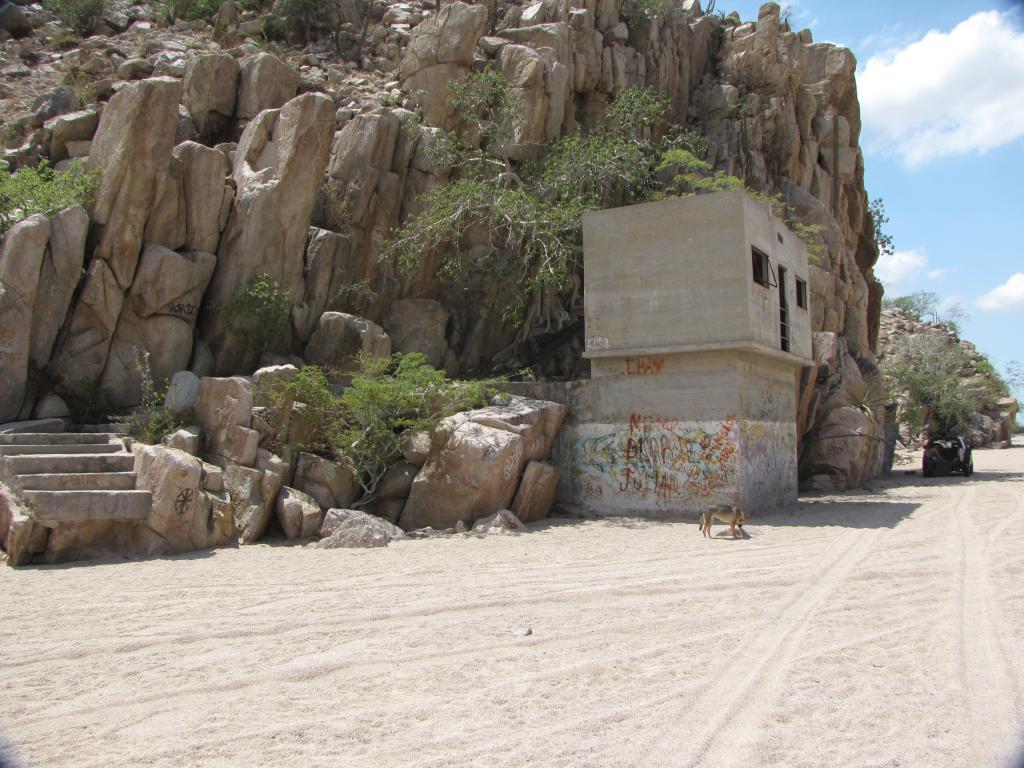
The bottleneck at Arroyo El Cajoncito

An old (1940s) irrigation project at the bottleneck

The
result of this unfortunate miscalculation by authorities was that in
about 10 hours the aguas broncas (raging waters) from the arroyo wiped
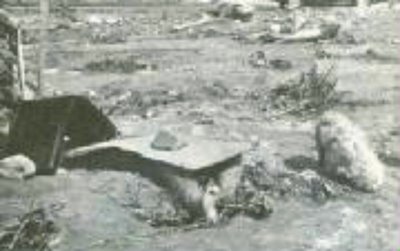
out about a quarter of the city of La Paz, an area that included some 30
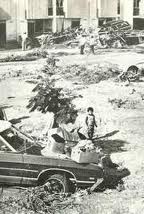
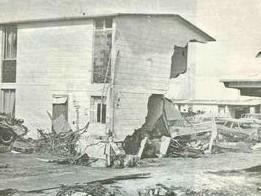
colonias. Concrete houses in the path of the flood were simply washed
away, leaving no trace of their ever having existed.
When
the houses were able to withstand the force of the water, often the
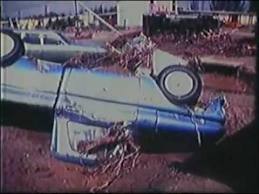
people inside drowned. Residents could only watch helplessly from the
banks as individuals and cars—some with whole families in them—floated
by, most to a certain death.
While
the real death toll will never be known–official sources place the
number of dead and disappeared in the mid-500s–some have estimated that
more than 10,000 people lost their lives that night, amounting to about
12 percent of the city’s population.
At
the time, it was the deadliest natural disaster in the nation’s
history, a mark that was surpassed in 1985 when an earthquake shook
apart Mexico City. Compounding the problem of an accurate count of the
deceased (if the Mexican government had really wanted one) was the fact
that most of those who died were recent arrivals to the city, many of
them residing in “irregular communities.”
Few
natives lost their lives. I’ve lots of Paceño friends, most of them
from the city’s old families and not one of them lost a relative in the
disaster. The reason most likely is because they all lived near the
city’s center and not in the southeastern corner that was devastated.
Although
Liza was the wettest storm to strike the city in over a century, a
post-disaster review of the events leading up to the catastrophe
indicated that the calamity was far from unpredictable. In fact,
Sebastian Diaz Encinas, a hydraulic engineer who had been involved in
flood control issues in the region since the 1940s, had been sounding
the alarm and warning of just such a thing happening for several years
before the arrival of Liza, but nobody was listening.
Events Leading Up to the Tragedy
Anyone
acquainted with the geography of La Paz knows that heavy rains can make
some of the city’s streets impassible at times. Because of its location
on the delta of an alluvial plain formed by arroyos that dewater the
nearby sierras during rains, sections of La Paz have always been prone
to flooding whenever storms passed through the region.
The city’s total lack of storm drains to help purge its streets only aggravates the problem.
Prior
to 1960 the town was small enough that there was still plenty of
undeveloped “safe land” so people didn’t build in arroyos.
When
floods came, they were little more than an inconvenience for most of
the city’s residents, although there have always been the occasional
innocents who have paid with their lives for not recognizing the danger
of the swift currents that are sometimes
unleashed from the sierras.
In the 1960s the pace of the city’s growth picked up.
The
agricultural colonies that were established in the 1940s and 50s in the
Santo Domino Valley, Los Planes, Todo Santos and around La Paz began to
bear fruit, attracting more people to the southern peninsula. Many of
these recent arrivals chose La Paz as a place to settle once they had
fulfilled their agricultural contracts. When ferry service connected the
territorial capital with the mainland in 1964, the peninsula’s
duty-free status also stimulated the city’s development as an army of
petty capitalists invaded the city’s main business district shortly
after each ferry’s arrival at Pichilingue. Some of them undoubtedly
stayed on.
The
completion of the Transpeninsular Highway in 1973 brought even more
people to the southern peninsula in search of better economic
opportunities.
It
took 140 years for La Paz to reach a population of 17,000 people,
something the city achieved in 1950. It took only twenty years to triple
that number, so that by 1970 more than 51,500 individuals called the
city “home.” By then, the only lands available “in town” were in the
flood zones. But the city continued to expand anyway.
Irresponsible
or corrupt public officials looked the other way as waterways were
invaded and often filled in with garbage and other debris by people who
knew nothing of the dangers of flash floods in desert environments.
Rather than uprooting the informal communities that sprung up in
dangerous areas and having to find more suitable (and expensive) lands
for them, officials decided it made more sense to incorporate them into
the system where they were, providing the new colonias with public
services and, of course, taxing them. No sooner did one paracaidista
(literally, “parachutist” which means “squatter” in this context)
community get legal recognition, another would form a little further
out.
In
the late 1960s territorial officials decided to protect the new
colonies from the occasional floodwaters that come out of El Cajoncito
Arroyo by building the now-infamous first bordo de contencion
(containment boundary). The plan called for building a three kilometer
earthen dike across the gap separating San Juan Hill and Atravesado Hill
(these are the two principal hills one sees behind the city when
looking at La Paz from a boat or from the Mogote). The idea was a good
one, since—if done property—it would effectively divert the waters
coming out of the sierras east of town around the city to the big arroyo
that passes next to the university south of La Paz (Arroyo El Piojito).
Unfortunately,
federal officials chose to fund the cheapest of the three proposals
submitted. Factor in the usual graft and corruption that accompanies
these types of projects in Mexico and what was finally built was a 10-meter-high sand barrier with a rock surface facing the arroyo, cement was used sparingly in its construction.
The project was completed to great fanfare in 1970 or so.
The
bordo provided a sense of security and became the de facto eastern
limit of town as the lands right up to it were soon urbanized.
I’m
not aware if the bordo was ever put to the test by a hurricane in the
few years between its completion and the arrival of Hurricane Liza.
In
normal conditions, the waters that run down the arroyo don’t jump the
steep sand banks that are characteristic of it through most of its
passage east of town, so waters from Cajoncito Arroyo wouldn’t
ordinarily have been running along the bordo. But what happened with
Liza was that an inordinate amount of water fell over a very short
period of time, water which apparently backed up behind the bordo while
making its way behind Atravesado Hill to Piojito Arroyo.
Once
the section of the bordo gave way, the arroyo reclaimed its old
waterways to the sea through the southeastern sector of the city.
It was a “had to be there” moment to fully appreciate what had happened.
Most
of the city’s residents didn’t realize the cause of the “explosion”
heard that early evening and word didn’t filter back to the rest of the
city of the horror that had visited the eastern and southern sections of
town until the next morning.
While
my family was long gone when Liza devastated La Paz, I had several
friends who were volunteers at the La Paz offices of the Red Cross in
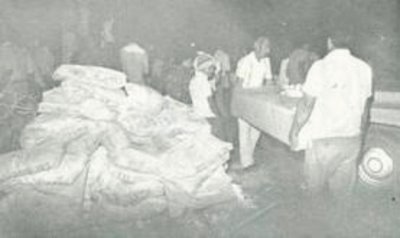
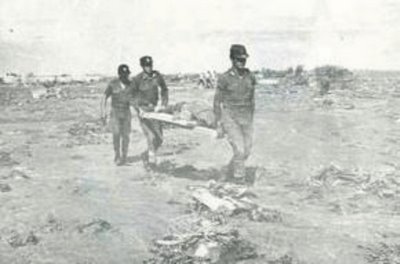
1976. All of them were called in to begin hauling bodies in the pre-dawn
hours of Oct. 1st. Initially, the corpses were taken to the Salvatierra
Hospital (then on Bravo Street), but as this facility was soon
overwhelmed, the dead were taken to the Cancha Manuel Gomez Jimenez on
Bravo Street and to the GUM Gym on 5 de Febrero (right on the very edge
of the arroyo) and several other locations around town.
The initial idea was to give next-of-kin a chance to claim their relatives.
But
as the magnitude of the devastation was realized, government officials
decided that the original plan was impractical as bodies quickly began
to decompose in the tropical heat. Two backhoes were ordered to the
Sanjuanes Cementary where they dug five trenches, each some 70 yards
long. The dead were wrapped in make-shift sheets (they bought bolts of
cloth from local stores to make them) and dumped one body on top of
another in common graves. Six tons of cal (lime) were used to cover the
dead to help contain the spread of disease.
It
didn’t take more than a few days for public officials to call off the
search for bodies, deciding that the arroyo was as good a place as any
to be buried. Today one still occasionally hears of a construction site
finding human remains in the sections of the city that were flooded.
In
doing the research for this essay, I visited the site where the old
dike was located, I rode my bike down the arroyo that overflowed with
death on that September night and also rode to the top of Atravesado
Hill to survey the area where the nightmare began.
I
studied the new fortifications that protect the city from the Cajoncito
Arroyo today. What I found is a bit disconcerting, to say the least.
While the north section of the new retaining wall is a beauty with a
cement face on the arroyo side, the southern section—the very section
that collapsed last time—is (once again) made of dirt/sand with a rock
surface facing the arroyo.
Although
I’ve never seen a good picture of the old dike, the southern section of
the new dike looks a lot like the descriptions I’ve read of the
original.
What
one also sees are new sections of La Paz growing up in places that have
virtually no protection from the arroyo, colonias that will be in grave
danger when another Liza hits this area again.
If
I were shopping for a house in La Paz, I would study where the old
arroyos ran, particularly the Arroyo El Palo, which was one of the
deadliest arroyos crossing La Paz on the evening of September 30th,
1976. During Liza, sections of Jalisco, Sinaloa, Colima and Colosio
Streets were deathtraps for those caught in them.
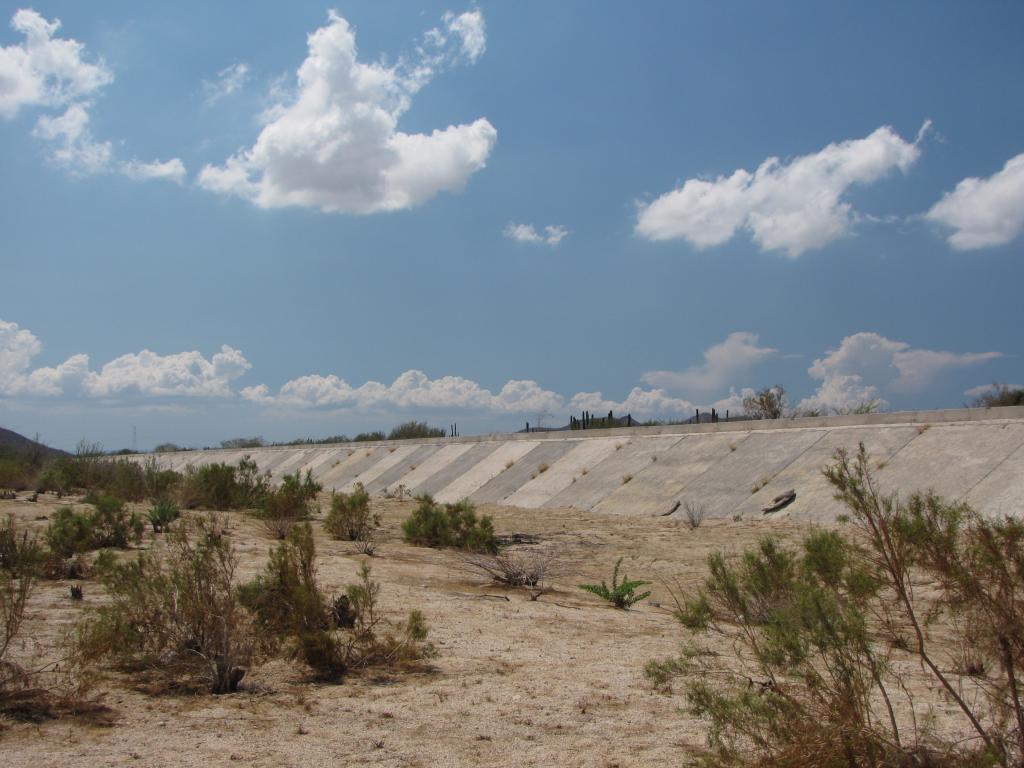
The new cement “bordo” protecting the downtown area

What the bordo protecting the area devastated by Liza looks like

Interesting Tidbits
The
literature—as well as my friends’ accounts—mention the suspicion that
the dike was really blown up with explosives by the Army.
This
theory proposes that government officials were monitoring the situation
and realized that it wasn’t a matter of “if” but of “when” and “where”
the dike was going to give way.
If
a section of the dike’s north end gave out, Arroyo El Cajoncito would
have flooded downtown, the city would likely have suffered greater
damage and perhaps more deaths. Under this scenario, public officials
would have coldly decided to sacrifice the sections of the city where
immigrants lived to save the city’s center.
The
President of Mexico, Luis Echeverria, visited La Paz on Oct 2nd and
promised the local governor that “whatever you need, just ask and we’ll
send it.” At the time, Echeverria was trying to make Mexico more
independent of US influence and so chose to reject the aid that was
collected and offered
by
its northern neighbor. Unfortunately, the federal government wasn’t
able to provide what it promised, which left local hospitals in a bit of
a jam.
In
what sounds like an effort at revisionist history, the governor who
presided during the storm stated in a recent interview that he made the
decision to ignore the presidential order and allowed aid flights in.
One
of my Red Cross friends said that only one US Air Force C-130 cargo
hauler landed with supplies, which were promptly confiscated by the
military, never to be seen again.
It took eight days for power to be restored to most of the city.
The
dam known as La Buena Mujer (The Good Woman) was built as a response to
the devastation caused by Hurricane Liza. It now serves as a reservoir
for the runoff of one of the major arroyos that feed the waters that run
through Arroyo El Cajoncito.
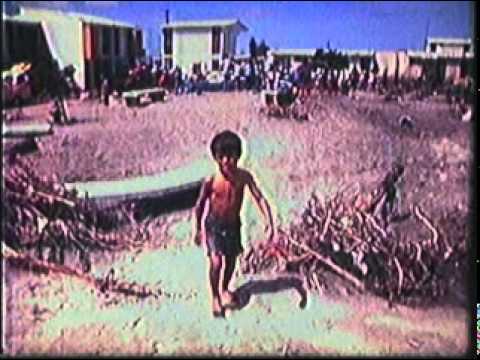
Although
it’s narrated in Spanish, you don’t need words to appreciate the
graphic scenes of death and destruction. At around 27 seconds into the
video, during a low-level flyover, one can see the gap in the old dike.
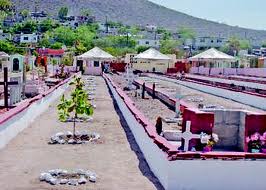
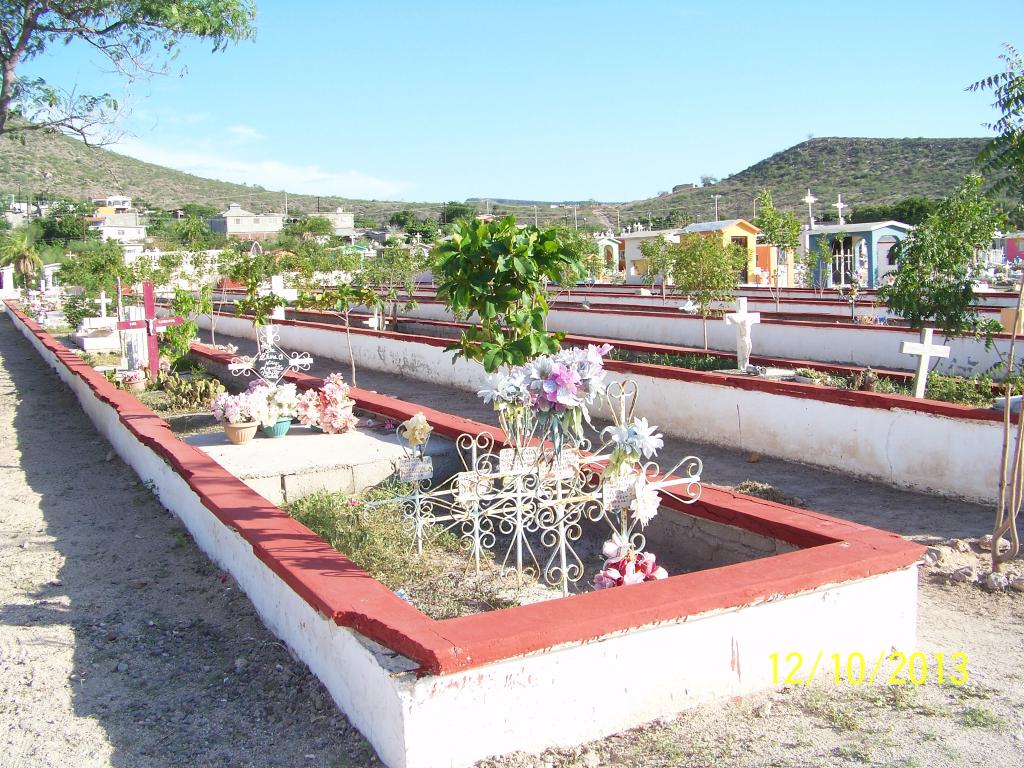
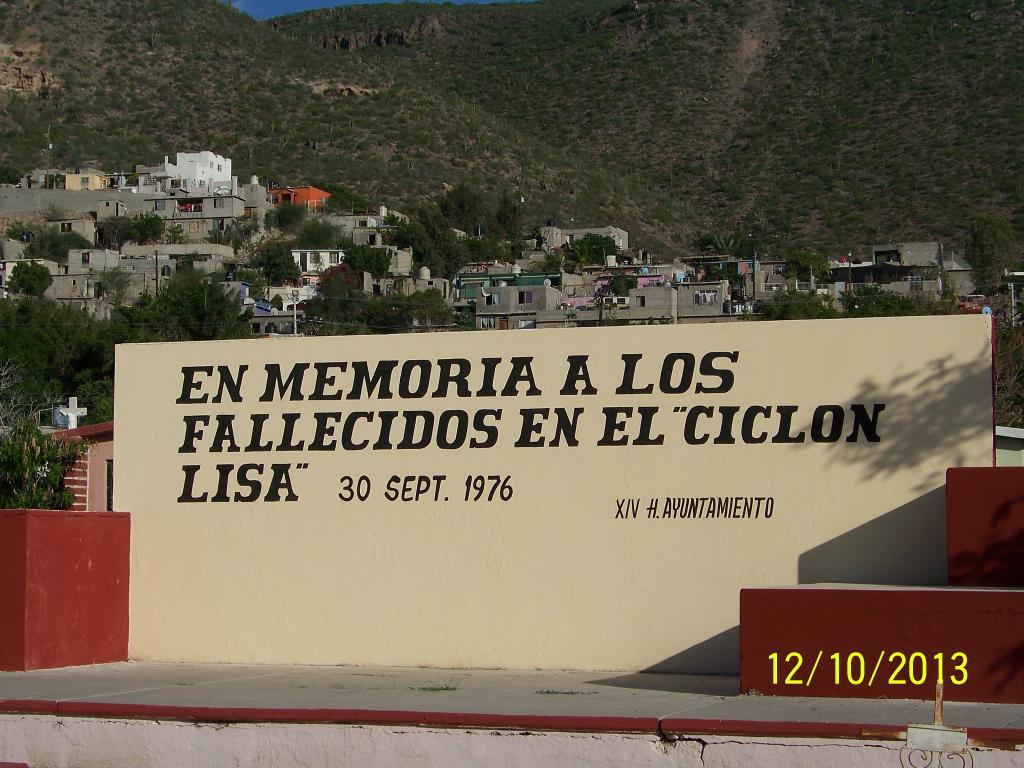
The five trenches where the dead were laid to rest
 The marker commemorating them
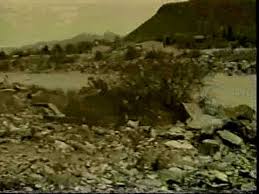
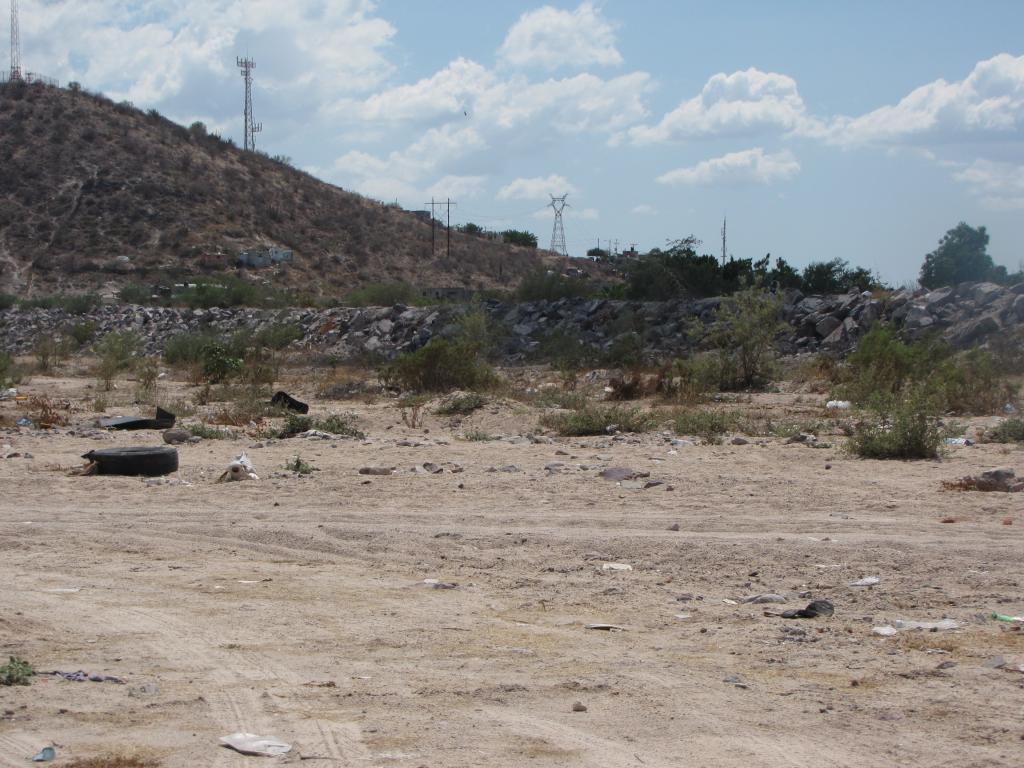
 The gap where all the water came through
 The section of La Paz that was wiped off the map
The
following story appears online in Spanish. It is an account written
(or, more likely, narrated into a recording device) about one person’s
experience during Liza and is quite moving. In its original form, it is
one very long story that makes little or no use of punctuations,
paragraphs or any of the other norms of writing. In my translation, I
have taken the liberty to break it up into more readable blocks of
information and omitted some passages that were repetitive or didn’t add
to the storyline. The original story, with many photos of the
devastation caused by Hurricane Liza, can be found at:
I SURVIVED CICLON LIZA 1976
By Casimiro Gardea Orozco
My
story begins on September 30 of 1976. I remember getting up early to go
to work with my stepfather, with whom I was working practically since I
arrived in this city. I’d arrived in La Paz in August of 1975 onboard
the Salvatierra, the ship that later sank in front of Espiritu Santo
Island.
I
remember on that fateful day my stepfather and I went to finish
plastering some commercial locations we’d built for a man over in front
of the military base. We were getting close to finishing the job when my
stepfather told me and another guy who worked for him—I think his name
was Valentin—that the owner said we should knock off for the day and go
home because the hurricane was going to hit the city, so we cleaned and
stowed our tools.
By
then I think it was about 10:30 a.m., we finished up and bid each other
goodbye. My stepfather left on his bicycle while I headed home on foot.
I hadn’t walked five blocks when it began raining, so I hurried home,
where I arrived soaking wet. Without changing clothes, I announced my
arrival to my mother as she attended to my youngest brother and told her
that the hurricane was about to arrive. I began to cover the windows
and door of the house the best I could, nailing a thick blanket to the
door and putting cement blocks along its bottom to help support it
against the strong winds that had begun to blow. I had to restack the
blocks every so often after the winds would push them over.
At
around 3 or 4 in the afternoon a calm arrived over the city, which
allowed me to go outside to check on things in our yard. As I was doing
this my stepfather, also taking advantage of the calm, arrived in a
station wagon to take us to the military base which was being used as a
refugee center.
But
it soon began to rain and the winds returned stronger than ever. Taking
only our blankets, we piled into the wagon and began driving down
streets that had become flooded arroyos, seeking a way to our
destination.
The rain was so heavy that at times we couldn’t even see where we were
going. We got stuck numerous times but managed to continue on, until the
roof of a house fell in front of the vehicle and we decided that it
would be better to return home. As we headed back we got stuck in the
mud repeatedly and our vehicle took several hits from airborne debris.
Several times we had to practically carry the vehicle out of the
rain-swollen arroyos, which seemed to get deeper with each passing
moment.
After
a two-hour struggle, at around 6 p.m. we finally made it back to our
home. Before we got out of the vehicle my mother’s compadre came up to
invite us to wait out the storm at his house, which was made of cement
block and also had a cement roof (Tripper note: this passage indicates
that the family lived in a house made of materials that were temporary
in nature, a practice common in Third World countries). It seemed like a
safe place for us and the other four families already there to take
refuge.
As
we settled in, drank coffee and chatted we all felt comfortable and
safe, the mood was light-hearted as we thought the worse part of this
experience was behind us. We talked about the places we were from. We
had all come from other parts of the country to seek work in La Paz
because we thought it was like going to the United States to earn
dollars since it was in the zona fronteriza (border zone) and there was a
lot of tourism and we thought everything was paid for in dollars.
After
about three hours of this enjoyable banter we heard a sound very
different from the noise of the wind and rain that had been plummeting
the roof and walls that surrounded us. It was a deafening sound
accompanied by a small tremor that seemed to get nearer and nearer to
us. A young guy about my age who had been visiting decided that it was
time for him to return to his home.
He
left, but soon returned because the currents in the arroyo were too
strong to cross. By then water was intruding under the doors in spite of
the blankets that had been placed under them to prevent such leakage.
That was when we heard one of the walls of an adjacent empty room in the
house collapse.
This was followed by the sound of rushing water hitting the walls of the room we had just vacated.
We
realized that soon the whole house would be brought down by the force
of the water rushing by. My mother’s compadre said we should leave the
house and climb aboard the motorhome parked outside the residence, which
we all did. Wood and other building materials from houses the waters
had already destroyed piled up in front of the property we were at,
parting the waters and forming an island that gave us sanctuary. But
then we began to feel the impact of the material from the house we had
just vacated as it began hitting the undercarriage of the motorhome we
were in.
One
of the men in our group said he heard a child crying under the
motorhome and so he and my stepfather went outside to search for him.
That
was when the last standing wall of the house we’d been in gave way,
falling into the motorhome and knocking it over onto the man my
stepfather had accompanied outside, killing him. Logically, we assumed
my stepfather had suffered the same fate.
But
luck was with him. He recounted several days later that when the
motorhome fell over, it created a huge splash which lifted him up into
the arms of a large cardon cactus that was in front of us. He spent
several hours up in the cactus, until the waters running in the arroyo
were low enough for rescuers to arrive and help him get down.
He
showed me the many thorns still embedded in his body, which doctors had
decided to leave in place until his body expelled them naturally. From
his perch that night, my stepfather had to watch helplessly as his
entire family was swept away, one by one, by the raging currents of the
arroyo.
When
the motorhome turned over, the first thing we did was pray to God and
then decided that it would be best to get out of the vehicle and try to
reach the roof. We got the women and children out first. But no sooner
did we get a person out that the raging waters would sweep them away
because there wasn’t anything to hold onto. Eventually, only the other
kid my age and I were left on top of the vehicle. Although it was dark,
there was a visibility akin to a moon-lit night which allowed us to see
our surroundings in a limited way. It seemed like we were in the ocean,
for water was all around us as far as one could see. The two of us were
in that situation for about twenty minutes when we felt the vehicle
begin to float under us.
That
was when I heard a baby cry out. I was able to spot him floating on
some wood nearby. The humanity in me drove me to leave the relative
safety of the motorhome “island” and try to rescue this fellow human
being. But before climbing off the motorhome I told the other kid that
he should grab a piece of wood from the debris to use as a flotation
device, just in case. I don’t know if he understood me, but when he
didn’t react, I grabbed one myself and handed it to him before setting
off to rescue the baby. As I crossed over wood and other debris, I could
tell everything was floating, for it felt as if I were jumping on a
couch. When I reached the baby, I realized he was my younger brother. I
took him in my arms and started back for the motorhome. With the other
guy’s help, I was beginning to climb back aboard when a large wave
knocked me off balance and swept my baby brother and the other guy into
the river below.
Once
I climbed back onto the motorhome, I felt very alone, but soon another
wave hit me. I felt the skin of my fingertips get torn away as I tried
in vain to hold onto the vehicle. Then I, too, was swept downstream. At
times I was dunked underwater before popping up again to catch my breath
before being dunked once more as I was pushed along by the rushing
waters. I don’t know how, but I was able to grab a hold of a large piece
of wood floating near me. With the wood’s buoyancy, I was able to
minimize the dunkings I had been subjected to before.
As
I was being rushed along, more than once I was able to make out
upcoming fence posts that had barbed wire between them. I knew the grave
danger these posts represented, so when I couldn’t avoid them, I tried
to get my body as horizontally as possible so as to pass between the
strands of wires like a board. I had to do this maneuver several times
during my journey down the flooded arroyo.
At
one point, I could make out the posts of high tension wires and tried
to navigate myself over to one of them to try to latch on, but to no
avail.
A
pocket of air formed in front of the cement base that wouldn’t allow me
to even slam into them. At times I lost my grip on the wood I was using
for flotation and was at the mercy of the currents. I could feel large
rocks being swept along underneath me, just brushing against my legs but
never doing me any harm, thank God.
At
times during my journey, the water became shallow and I was able to
stand up, only to be knocked down once again when the rushing water
flushed the sand out from under my feet. I tried standing up several
times but was never able to stand for long, so I quit trying, letting
the water hit my back in full and rush me past large distances until I
was in deep water again. In deep water my main concern was staying
afloat and keeping my head above water.
As
I was floating along, I suddenly heard another sound the water was
making, which I recognized as the sound of an upcoming waterfall like
the ones I’d known back home in Chihuahua.
Just
as I knew to avoid the barbed wire fences because I’d seen how they
could kill cattle caught in them when arroyos occasionally flooded back
home, I also knew the danger waterfalls represent.
One
could be knocked unconscious or break bones during a fall and that was
my immediate fear. But there wasn’t anything I could do but resign
myself to my fate and try to brace myself mentally for what was to come
next. Just as I was being swept over the fall, I suddenly felt my
progress halt and felt the full force of the rushing water engulf me. I
struggled to get my head out of it to breath.
My
legs were pinned down by the water’s force as I continued my struggle
for air. At some point, I realized that what was left of my pants had
been caught by the roots of a small tree that was also struggling for
survival against the water’s rage.
I
don’t know how, but I somehow managed against all odds to grab the
trunk of the tree and was able to briefly stand on the arroyo bottom.
But I realized that this action was causing the soil holding the small
tree in place to be washed away, so I let the water take me horizontally
again while I held onto the tree. I was in this position for some time,
watching helplessly as other people were swept pass me and over the
waterfall, a fate I should have shared with them. Sometimes, I could see
them stretch out their arms towards me for help, but there was nothing I
could do for them under those circumstances since they were out of
reach and I was up to my chest in the water and unable to move.
I
remember gradually distinguishing sounds other than the raging waters
and suddenly realizing that someone was yelling at me from the houses of
INFONAVIT and telling me to hang on just a bit longer while they helped
me (Tripper’s note: INFONAVIT is just north of Soriana’s on Forjadores
Street and is one of the colonias that was hit hard by Liza’s
floodwaters). I looked around for where the calls of help were coming
from specifically and saw a person who was using a flashlight to light
the area around me. I thought that he must be yelling at me and that was
when I reacted, asking for his help.
But
I don’t thinkhe heard me since he was flashing his light on a large
wall that was in frontof me just after Forjadores Street. I could see a
lot of people shelteredin a building with white walls and could make out
the silhouettes of otherpeople who went back and forth but couldn’t
leave their locationbecause the water was rushing past them on either
side.
My
would-be rescuer came towards me and I heard him, clearer than
before,say that he was coming for me, but I didn’t see him get any
closer to me.
Then
I suddenly heard someone about 30 meters away from me say he was going
to help me and that I needed to hang in there just a little longer.
That
was when I finally saw a silhouette nearing me, holding onto what
appeared to be a slide or some other type of playground equipment until
he could reach me with his extended arm and tell me to grab a hold of it
and not let go. And that is just what I did. I let go of the little
tree’s trunk as he pulled me out of the arroyo and then he backed up and
told me to follow in his footsteps until we reached the sidewalk in
front of colonia INFONAVIT where there is now a rock wall.
We
began walking towards Sinaloa Street. When we reached Jalisco Street, I
remember seeing a man inside one of those cages that use to protect
water mains. We told him to get out from the cage and come with us
because he’d surely drown in there if the water level rose again.
But he refused to listen to us and instead went further into the cage.
We
continued walking until we reached the old road heading south, walking
along a long line of cars that had been trapped between Sinaloa and
Colima Streets. Everyone looked at us with shocked expressions on their
faces, but nobody came near us or talked to us.
Seeing
us in rags, seminude and full of mud, they simply got out of our way.
Perhaps we were the first people they had seen that managed to get out
of the raging floodwaters . Perhaps they didn’t find out until the next
day of the magnitude of the tragedy that the city of La Paz was living
through.
Perhaps at that very moment lots of people were still floating, dead or alive, in the bay of La Paz.
We
walked until we reached the corner of Sinaloa Street and Forjadores,
were we attempted to cross the street but failed because the current was
too strong so we sat down with our backs to a wall to wait for the
waters to recede. We sat there, resting for a while when a woman from a
house that still exists to this day invited us in to her home (Tripper
note: a business has replaced this house). She said there were lots of
people in the house already, but that we could stay in one of the cars
in her yard and she then opened the door to one of them.
She
left to prepare us a cup of hot tea. Once inside the car, the interior
light came on and that was when I realized that the guy who had helped
me was the same one who was in the house with us earlier that evening.
But
we hadn’t spoken since he’d told me to follow in his footsteps after
pulling out of the water. I also noticed how he rubbed his right hand
and how his little finger was suspended from his hand by a thin piece of
tissue, which he apparently hadn’t noticed until that moment.
When the woman returned with our tea I asked her for some scissors.
Without
asking a thing, she left and returned with them. I used them to cut the
tissue still attaching his finger to his hand and wrapped it in a
neckerchief I found on the car’s seat and put it in his hand.
He
held onto it tightly as I drifted off to sleep. When I awoke, he was no
longer in the car. I, too, left the car. Sinaloa Street was now empty
of water. I walked about two blocks and could still hear water rushing
down other arroyos. Suddenly, some soldiers appeared out of nowhere and
asked me what I was doing there and said it was very dangerous there
because of the arroyo. I told them I’d escaped from the arroyo and that
was when I saw the first dead people among the piles of debris of
boards, wood, tree branches, furniture and everything else that was
along the arroyo bank. Some corpses had arms or legs jutting out from
the piles while one could see the backside of others as their heads and
legs were buried under piles of trash. The soldiers were picking up some
of the bodies, those with uniforms. It seemed like they were only
separating their own from the debris.
One
of the soldiers took me to the soldier in charge of the scene and told
him I’d managed to escape from the torrential waters. The man in charge
told my escort to take me in a jeep over to a school that was being used
as a refugee center, which he did. I don’t remember which school he
took me to, but what I do remember was that as we transited the streets
sometimes the water was deep enough to almost cover the jeep’s tires.
When
we arrived at the school, the soldier told the person he turned me over
to not to let me out of his sight, and he didn’t. I was brought a
blanket and taken to a classroom where I looked out a window and saw how
the water was still rushing with considerable force by the side of the
building.
I fell asleep again. Around dawn someone woke me up and asked if I was injured.
I
showed him my hands and he told me to get aboard a truck that would
take us to the hospital to be checked out. Some of the others on the
truck had large head injuries while others had injuries on their legs
and arms and still others were unconscious.
After
we arrived at the hospital it was several hours before a doctor asked
what was wrong with me. I told him the skin on my fingers was peeled off
and I had been hit in the stomach. He checked me out and said nothing
was wrong with me but washed my hands with oxygenated water and said
he’d get me some clothes. When he returned with a pair of pants and a
shirt, I put them on right then and there and left the hospital, heading
up Nicolas Bravo Street (Tripper note: this is the street the old
Salvatierra Hospital is on).
As
I neared the area affected by the storm I began to appreciate the
enormity of what the flood waters had done. When I arrived at the arroyo
there wasn’t any more water in it. In fact, it looked as if it had
never had any water in it at all. Sections of it were so clean that they
looked as if they’d been swept.
The
sand was so white that the sun’s reflection off of it strained my eyes.
I began to see the half-buried bodies once more and a lot of people
looking for bodies and marking the spots were they found them. Pickup
trucks passed by full of corpses covered with dirt and mud.
I
continued to walk towards our house. When I arrived I was surprised to
find everything was as we had left it. The blanket was still in place on
the door and the water level inside the house had only risen to about a
foot. In fact, it hadn’t even reached the mattress on the bed. I sat
down to contemplate what had happened when my older brother arrived and
asked me about the rest of our family. I told him the flood waters had
taken them all and we cried together.
Once
we calmed down we decided to go look for them. We looked in a lot of
places but never found anyone until we arrived at some soccer fields on
Allende Street. We watched as workers were washing off corpses with a
hose to clean them up so their family members might be able to recognize
them.
That
was where we found first, our six-year-old brother and then, inside of
the building, we found our mother—still holding our baby brother in her
arms. Somehow, when the baby slipped out of my grasp,
she was able to recover him while they floated downstream, never letting go of him, not even in death. We never found my sister.
Another
younger brother of mine was rescued by soldiers from the roof of a
house under construction near the Hotel Gran Baja (Tripper note: this
hotel, now empty, is on the shore of the Bay of La Paz and should have
had guests when Liza struck). He’d been washed down the arroyo and would
have likely drowned in the bay if not for a large nail that pierced
through his foot and anchored him to the structure, keeping him from
being swept to sea. He required over a year of medical treatment and
therapy to recover from his injuries.
After
this tragedy, my older brother suggested that the three of us should
intern ourselves into the Ciudad de los Niños (Tripper note: the Ciudad
de los Niños [City of the Children] is a local orphanage and is located
next door to the Santuario [huge church] on Cinco de Febrero), where I
became a trainee in the printing shop.
The
rest of the story talks about how he eventually learned the Graphic
Designer trade at the orphanage and still works in the trade today.
The End
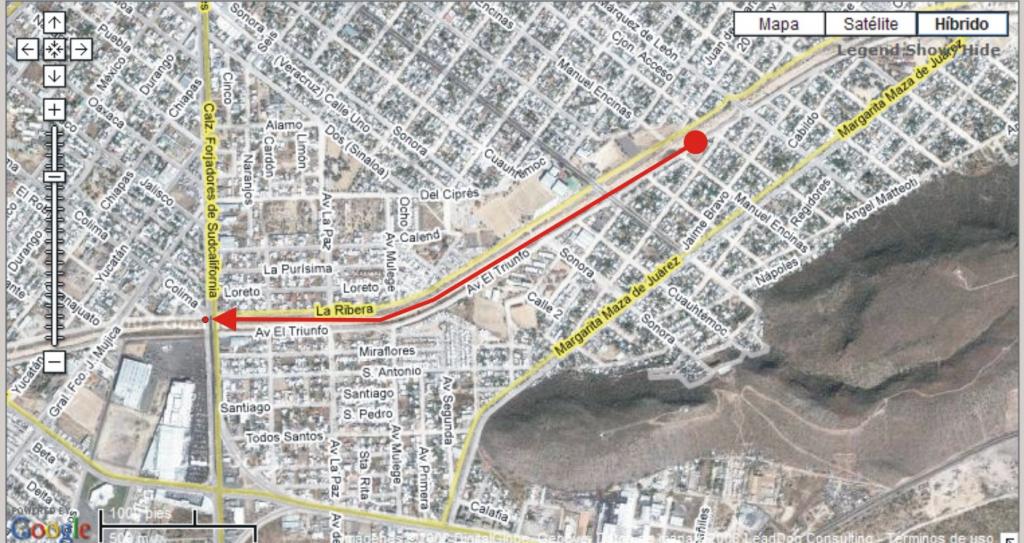
Where the house he was swept from was once located,
note the arroyo on the right.

Where he was pulled to safety, next to present-day Burger King Restaurant
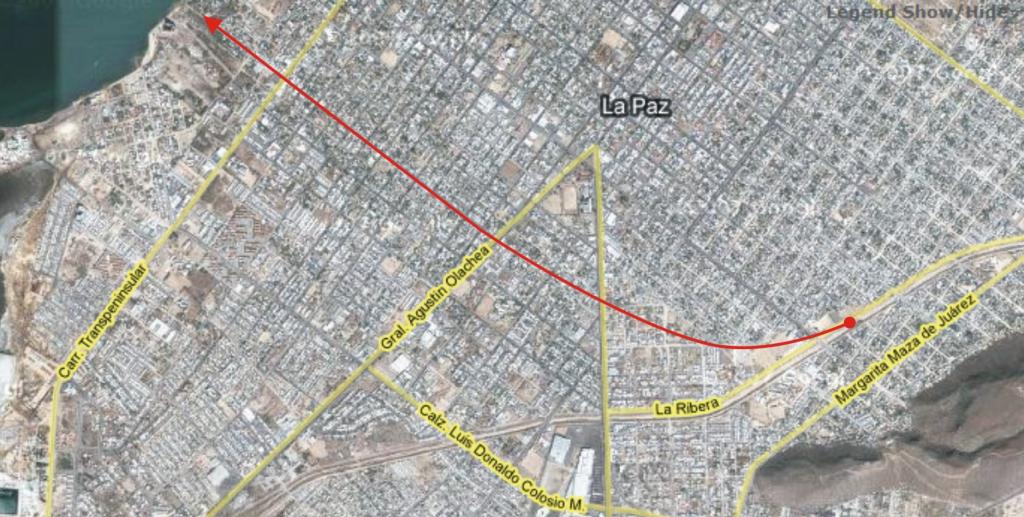
 The area he traveled down the arroyo

The area his brother traveled before finally getting “nailed” to a building under construction

We
drove down in December 1976 and were amazed at how the landscape around
La Paz had changed from the effects of the hurricane-everything super
green. Here is a photo taken in front of Martin Verdugo’s Trailer Park-
not much sand but lots of wood that got washed out from the desert and
then packed onto the beach. Martin Verdugo told us that the water was
waist to chest high and they had to hold their children up above the
water for a long time so they didn’t drown.

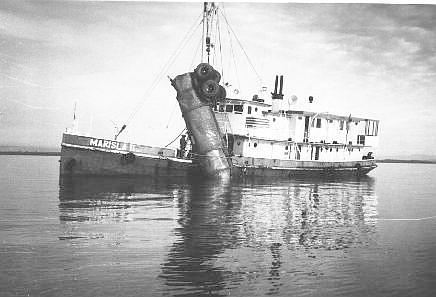
An interesting aside on the ending of the Salvatierra is related to
Hurricane Liza.

Either
the Ruffo’s (the ship’s owners) or their insurance carrier contracted
an American salvage company to come down and refloat the ship.
The
process was well underway–they’d brought with them sacks to inflate
with air inside the ship and bought just about every inner tube in La
Paz to aid with the effort and had the ship coming up just before Liza
arrived.
After Liza’s winds and tides passed through the area, the ship was hopelessly lost forever.
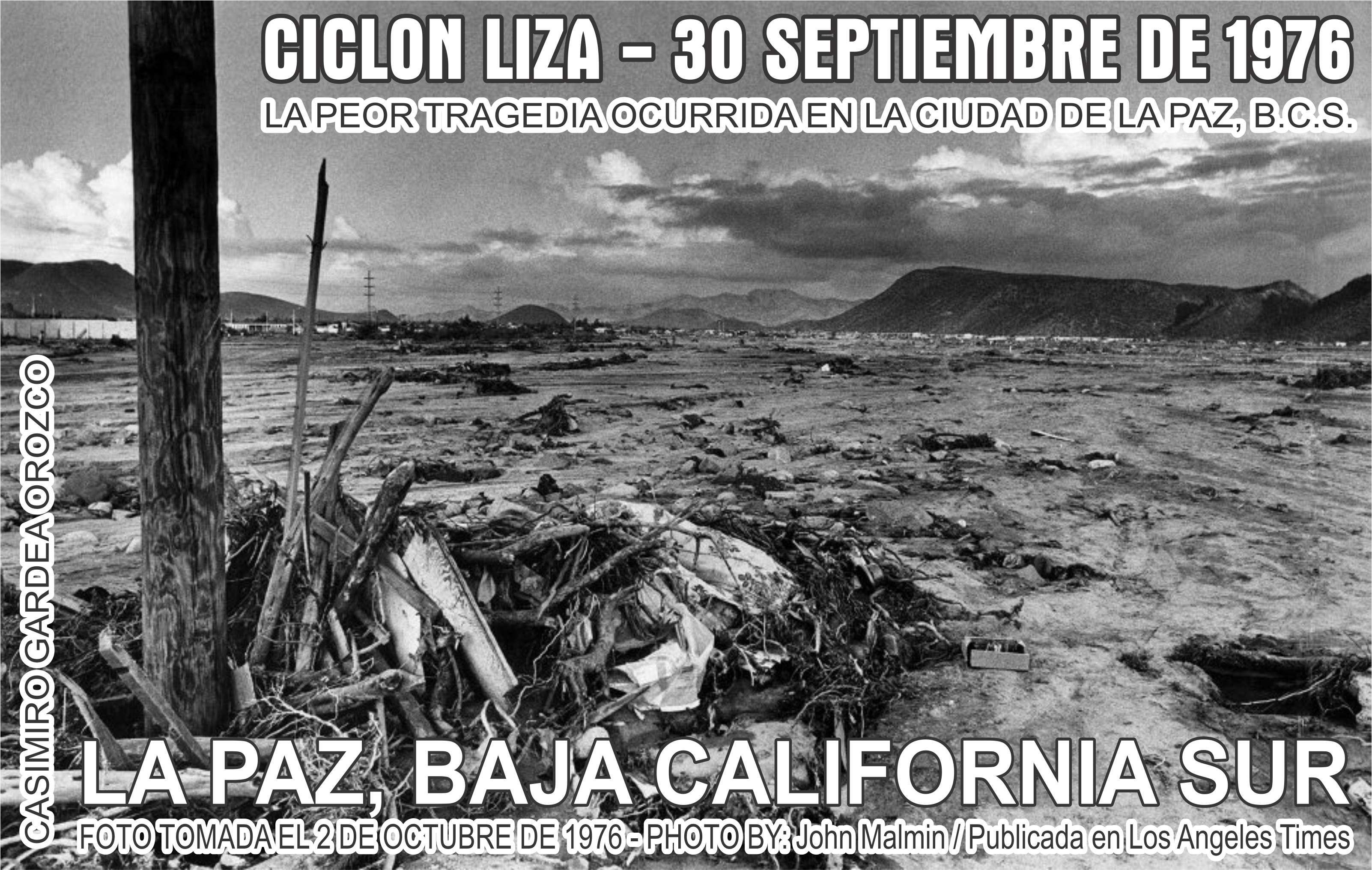
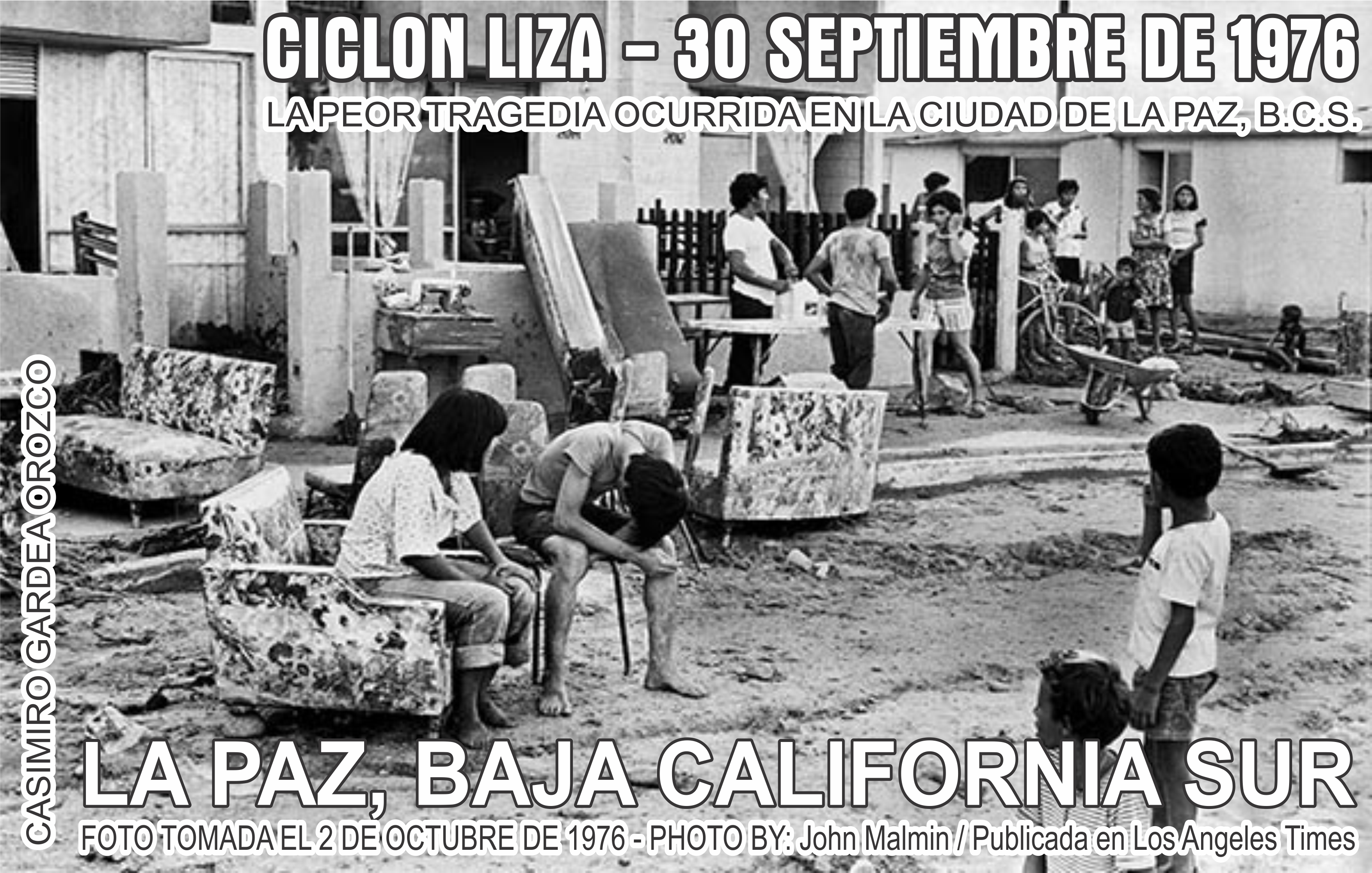
CICLON LIZA SEPTIEMBRE 30 DE 1976

NARRADO POR CASIMIRO GARDEA OROZCO